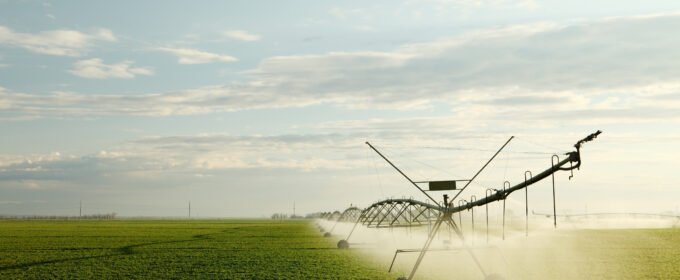


Farming and food security, in the UK, is increasingly exposed to drought and water scarcity. Yet, the UK government’s White Paper, ‘A New Vision for Water’, treats farming primarily as a source of water pollution, not as a sector whose productive capacity is closely linked to water security. The White Paper promises a once-in-a-generation reform but neglects the fundamental need to rethink how we manage water to support our national food security and rural economies. Here, Dr Tim Foster and Dr Christopher Bowden highlight how the Clean Water Bill could better support farmers alongside other water users and the environment.
- By 2050 it is projected that summer rainfall is likely to drop by approximately 15% and summer river flows by roughly 45%, making droughts more frequent and severe.
- Recent droughts have caused significant losses to arable yields, with direct costs to UK food producers running into hundreds of millions of pounds.
- The Clean Water Bill (the Bill) must prioritise agriculture as a key part of our water system and economy by placing an explicit statutory duty on the regulator to ensure drought resilience and preparedness, with food security embedded as a key criterion.
Impacts of drought on UK agriculture and food security
The White Paper rightly acknowledges that England’s ageing water infrastructure is “struggling to cope”. However, there is little to no discussion about how drought affects, and will increasingly compromise, the capacity of England’s agricultural sector to produce food and ensure supply chain resilience.
By 2050 it is projected that summer rainfall is likely to drop by approximately 15% and summer river flows by roughly 45%. Coupled with increasing volatility of rainfall and heatwaves, this will make droughts far more frequent and severe. In 2025, many regions entered winter with continuing drought conditions, with a continued dry spring meaning many farmers in the south and east of England are likely to face significant production challenges in the summer ahead at the same time as Peers in the House of Lords highlight an urgent need for the greater drought preparedness.
The agricultural consequences of these trends are already being felt. Our research shows to maintain current production levels, food processing infrastructure in eastern England may need to relocate northwards within the next decade, due to escalating drought pressures. Droughts in 2022 and subsequent years caused significant losses to arable yields, with direct costs to UK food producers running into hundreds of millions of pounds in 2025. Yet England’s regulatory framework offers farmers few options for adapting and responding to water scarcity: no tradeable water rights, no drought contingency allocation, and no financial safety net.
Where the White Paper falls short
The White Paper’s proposals have potential to deliver significant structural improvements in water management and policy in the UK. However, reforms fail to address several critical challenges related to how water is managed and governed within the agricultural sector.
Water rights
Our abstraction licensing system is over 50 years old with catchments across eastern and southern England – the most water scarce parts of the country – already chronically over-licensed or over-abstracted. The White Paper proposes moving abstraction regulation into the Environmental Permitting Regulations but says little about modernising the underlying allocation framework. Australia’s Murray-Darling Basin Authority operates a system of tradeable water entitlements with dynamic seasonal allocations that flex according to real-time storage and catchment conditions; several US states have introduced innovative tradable multi-year permit schemes that allow farmers flexibility to adapt and share water during times of scarcity. Our research demonstrates that flexible allocation systems substantially reduce economic and environmental costs of scarcity. Without comparable reforms, we cannot credibly claim to be building a climate resilient water system.
Monitoring
The White Paper has limited ambition when it comes to monitoring of water use, even though it is widely acknowledged that you cannot effectively manage what you don’t measure. For most abstraction licences, actual water use is rarely measured in real-time, and, within the agricultural sector, there is a significant reliance on self-reporting. Evidence shows that a lack of monitoring is a critical barrier to ensuring compliance and enforcement of water rights, particularly as pressures on scarce water supplies intensify. Our work on satellite-based monitoring shows that affordable, scalable technologies exist, with regulators and water managers in North America and southern Europe already using them to track agricultural water use and support efficient on-farm water management. Policymakers should be investing in such capabilities today, working in partnership with the farming sector, to ensure it is able to respond effectively to emerging water scarcity risks.
Framing
The White Paper rightly identifies agriculture as responsible for around 40% of river and groundwater pollution and commits to stronger enforcement of existing rules. This framing reduces farming entirely to a regulatory problem rather than a productive system that underpins national food security and is acutely vulnerable to water shortages. This matters for enforcement as well as resilience: water rights that cannot be practically exercised during drought create perverse incentives for illegal abstraction, undermining the very compliance framework the White Paper seeks to strengthen. The UK needs a firmer approach to enforcement of water rights with genuine financial and technical support for farmers to adapt and to mitigate risks posed by increasingly volatile and uncertain water supplies.
Water storage
The White Paper’s commitment to nine new reservoirs is welcome, but it reflects an approach that concentrates investment in centralised assets serving public water systems. This approach does not adequately address agricultural drought, which demands a complementary portfolio of distributed storage solutions, including on-farm storage, that can buffer irrigation demand against summer drought risks and reduce pressure on rivers and aquifers. Equally important, but entirely absent from the White Paper, is any framework for water sharing between farms and across catchments. Where individual holdings lack the land or capital for storage, collective infrastructure – shared reservoirs, irrigation districts, and water co-operatives – has proved effective in comparable agricultural systems in France, Spain, and Australia.
Recommendations
The Bill should give the new water regulator an explicit statutory objective to ensure drought resilience and preparedness, with food security and rural economic resilience embedded as a key criterion when evaluating and designing new systems of management and governance. Without this, water for farming will remain an afterthought in regulatory decision-making, leaving farmers and the UK’s food supply system critically exposed to drought and water scarcity.
The Bill should include provisions to fundamentally reform water rights and abstraction licensing. Dynamic seasonal allocations tied to real-time catchment conditions, transparent licence curtailment mechanisms for drought periods, and a framework for temporary water trading between agricultural users should be introduced. This could be supported by innovations in monitoring of water use and availability enabled by satellite remote sensing and other digital sensing technologies. This is the single most important structural reform the Bill could deliver for food security and farm sustainability.
Policymakers must pursue a comprehensive programme of water risk management and transfer for the agricultural sector – including regulatory support for distributed water storage and financial mechanisms such as index-based insurance and targeted grants for on-farm storage investment. These changes should be designed in tandem with a reformed abstraction licensing framework, with monitoring systems in place to ensure that seasonal and flexible abstraction rights are clearly defined and enforceable.
The government’s ambition for water reform is genuine and substantial. But a vision for water that treats agriculture as a pollution problem rather than a critical part of the food production system and rural economies risks building a regulatory architecture that is unprepared for the water challenges we will face in the coming decades. The Bill must prioritise agriculture as a key part of our water system and economy, without which food security and economic growth will suffer.