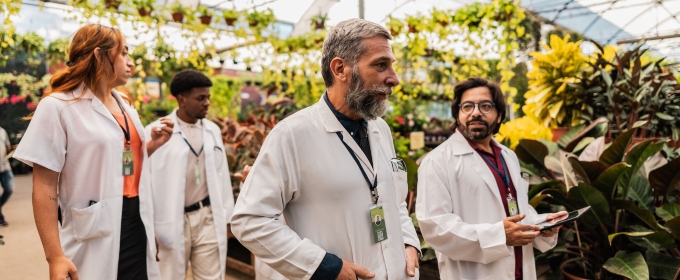

With climate change affecting our rising demand for sufficient food, affordable medicines, equitable healthcare, sustainable fuels and safe but effective agrochemicals; there is an increasing need to find new ways to produce these goods at scale. In this article, Professor Patrick Cai explores how synthetic genomics can address these global challenges and provides recommendations about how these technologies can be used responsibly.
- One of the biggest global challenges is our growing population and rising demand for food while arable land increasingly suffers from droughts and floods.
- Researchers from The University of Manchester are working on designing plant genomes that are drought tolerant and able to grow in unfavourable conditions.
- The UK is in a unique position to capitalise on its knowledge sector to commercialise biotechnological advancements, however, policymakers must ensure public trust with scientific advancements.
We have long been able to read DNA, but now we are starting to understand how to write it. By carefully designing a genome (a set of DNA instructions) from scratch, or modifying which genes are present in an organism – such as yeast – scientists are now able engineer these organisms for diverse applications. These include bioproduction of high-value chemicals and biologics, advanced cell therapies, and stress-tolerant crops.
Historically, synthetic genomics has been characterised by expensive, long-term projects reliant on technologies largely restricted to a small number of well-funded, specialised groups. However, recent advances in knowledge and funding in DNA design, synthesis, assembly and delivery are lowering barriers to research and are accelerating advancements, driving the transition from proof-of-concept projects to real-world applications.
Using synthetic genomics to feed the world
One of the largest problems facing the planet today is the need to feed its growing population. However, with many traditionally agricultural regions suffering from extreme weather events, such as floods or drought, crops are failing to thrive, and food production is at risk of being severely impacted.
Research at The University of Manchester is exploring how microbial communities act within an agricultural setting, and how they react to environmental stressors. This knowledge is then used to design plant genomes that are drought-tolerant or able to produce high yields despite growing in unfavourable conditions. Developing plants that can not only grow but thrive in challenging conditions is vital in those places most impacted by climate change such as sub-Saharan Africa, Central America, and low-lying and coastal regions.
Mitigating risk
While these technologies and developments offer vast potential to address large global challenges, they also come with inherent risks. Without proper foresight and control, these genetically engineered organisms may accidentally or intentionally find their way into the natural environment where they could have potentially harmful effects.
To control this, biocontainment mechanisms can be engineered into organisms to prevent them surviving outside of a lab or industrial setting. For example, research has shown using estradiol – a form of oestrogen – provides a way to prevent genetically engineered yeast from surviving in the wild. For the engineered microorganism to thrive, estradiol must be present which is very unlikely to occur in the wild.
In addition to environmental biosafety concerns, synthetic genomic technologies can pose a biosecurity risk because of their potential for dual use. Their now relative ease of access can enable malicious state or non-state actors to recreate and engineer dangerous pathogens, with potentially catastrophic consequences. So, it is imperative and strategic that safeguarding frameworks and technologies are developed and implemented to safely and securely deliver the revolutionary societal and economic benefits while at the same time minimising the risks for misuse.
An international team of world-renowned scientists, including researchers at the Manchester Institute of Biotechnology, have previously appealed to the scientific community to call for a moratorium on all research into mirror life. Mirror life is a mirrored version of an organism: every molecule in the natural world has handedness, they are either left- or right-handed, just like your own hands. Molecules only exist in one form, either left or right, but not both. Scientists had been exploring mirror molecules to better understand natural biology and to see if they offered any potential benefits, however the potential drawbacks outweighed the potential benefits if research continued without the proper legislative and legal frameworks in place.
This kind of foresight is essential when working with newly emerging technologies such as engineering biology as it offers protection for both the research community and wider public, while also preventing intellectual espionage and supporting our ever-growing bioeconomy.
Capitalising on the benefits of engineering biology
The UK is in a unique position to capitalise on its exceptional knowledge sector to commercialise emerging biotechnological advancements, putting itself at the forefront of the biotechnological revolution.
The UK also needs to advance and mature its regulatory frameworks in collaboration with the research community to ensure it supports this rapidly developing sector. When policy develops before the technology, it risks slowing down scientific advances and dampening innovation, exemplified by the GMO (Genetically Modified Organism) regulation in Europe. But when policy fails to keep up with technological development, the consequences have the potential to be catastrophic, as evidenced by the CRSIPR baby scandal in China in 2018, a scientific and bioethical controversy surrounding the use of genome editing following its first use on humans.
The establishment of The Regulatory Innovation Office (RIO) helps position Britain as the best place in the world to innovate by ensuring safety, speeding up regulatory decisions and providing clear direction in line with the UK’s modern industrial strategy. This provides a welcome vehicle for policy development, but the government still has a role to play in urging the RIO to prioritise regulation around engineering biology. Safety mechanisms are instrumental for the deployment of these emerging technologies, but there is a goldilocks zone to be reached for regulation to coevolve with technology.
Alongside regulation, there must also be a level of public support and understanding for technologies that will be adopted into society. Currently, the UK is lacking a public awareness and engagement campaign to effectively communicate the benefits of engineering biology. Lessons could and should be learned from previous genetic projects, and future engagement with the public should take into consideration the need for evidence-based messaging which is vital for the successful implementation of engineering biology into the UK.