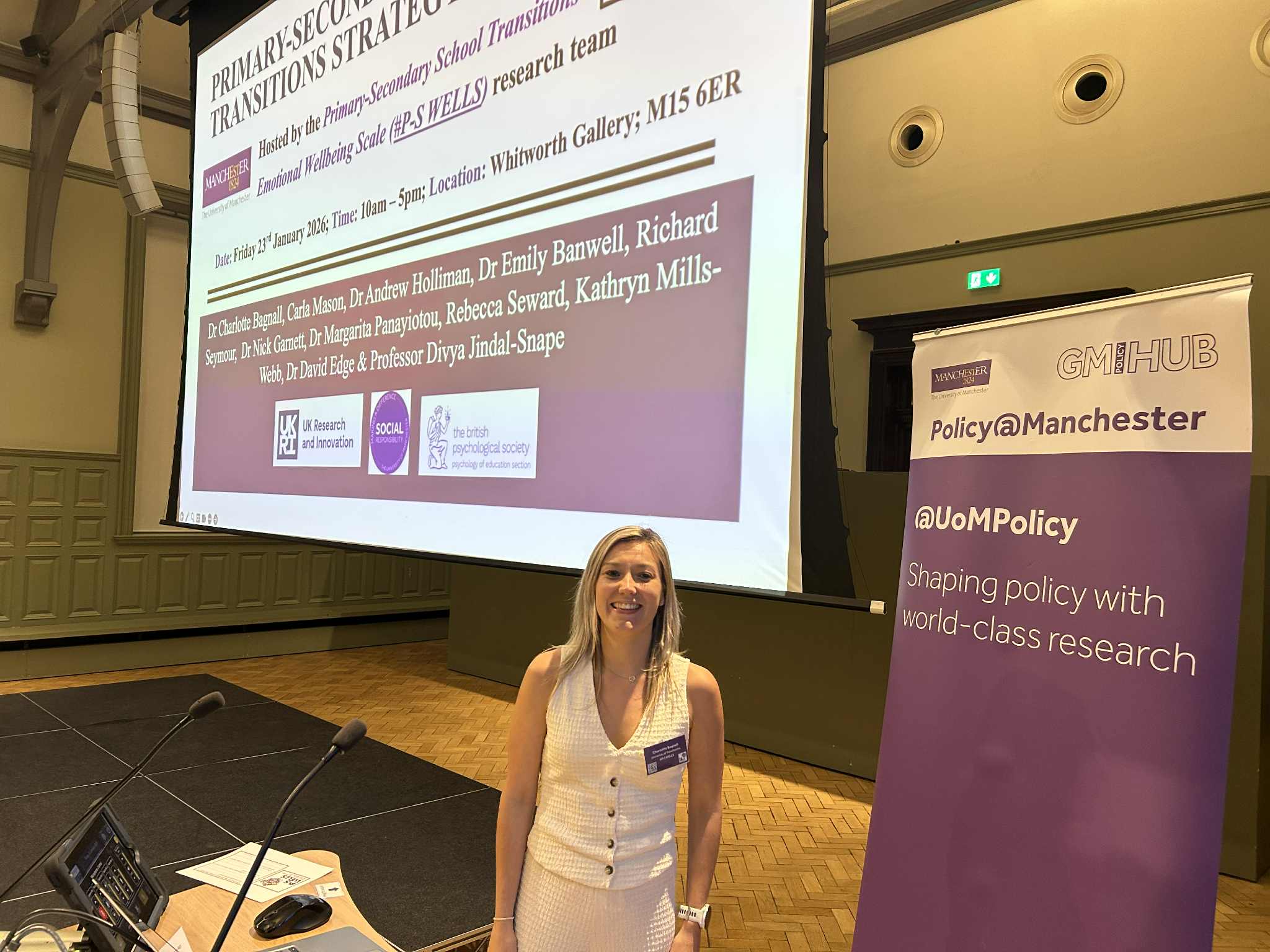

Over the past decade, government reports in England have consistently identified primary–secondary school transitions as poorly managed and a systemic weakness. Dr Charlotte Bagnall shares how her #P-S WELLS research team have combined academic research, with policy and practice consultation to co-develop a unified, evidence-based framework with key recommendations to inform a primary-secondary school transitions strategy in England.
- A unified, systemic and evidence-informed National Primary-Secondary School Transitions Strategy is urgently needed in England, supported by clear best-practice guidance.
- The #P-S WELLS research team have co-developed an evidence-based framework with key recommendations to inform a National Primary-Secondary School Transitions Strategy in England.
- The team are now calling for education policymakers to engage with further development and dissemination of their Transitions Strategy, and for local authorities to engage with the rollout and implementation of this work more widely.
Lost in transition?
Primary-secondary school transitions are emotionally demanding, critical periods for two thirds of children, who report stress and anxiety up to two years before starting secondary school.
Timely support for children is crucial, yet, in practice, the multiple and disparate challenges that primary-secondary school transitions present, such as academic discontinuities, relationship disjunctions, environmental and identity changes, can be difficult to manage, especially without a clear and consistent policy framework with statutory requirements and guidance documents.
Over the past decade, Government reports in England have consistently identified weaknesses and poor management of primary–secondary transitions and the Department for Education have reiterated that ‘a greater focus on transition periods in children and young people’s lives is needed’, with many children believed to be ‘lost in transition’.
Educational practitioners have raised issues of not knowing what to prioritise, how, and when. This has resulted in support for transition being locally interpreted by schools and local authorities, leading to variation in quality and implementation, under-resourcing, and/or shared gaps, underscoring the need for evidence-informed statutory guidance.
This inconsistent support is concerning as a growing body of evidence demonstrates the detrimental impact poor experiences of primary-secondary school transitions can have on children’s academic attainment, attendance, social adjustment and mental health, especially for more disadvantaged groups, which the #P-S WELLS research team are investigating through the design and validation of their scale.
PS-WELLS – combining research with policy and practice
The #P-S WELLS research team have spent two years analysing multiple stakeholder perspectives and multidisciplinary evidence to co-develop a unified, evidence-based framework with key policy recommendations to inform a National Primary-Secondary School Transitions Strategy in England.
An innovative design was followed, with the team synthesising UK research published between 2008 and 2025 identifying, evidence-based priority areas to improve this period.
Building on these insights, 15 round-table discussions were then conducted to aggregate multi-disciplinary perspectives of 75 experts leading on primary-secondary school transitions provision within educational practice, research and policy, nationwide. These discussions looked to identify existing barriers and facilitators in implementing “gold-standard” transition provision for the child, school, local authority and national level, and what key priority areas, should be included in a National Primary-Secondary School Transitions Strategy to best support stakeholders at each level.
A national strategy – approach and implementation
The #P-S WELLS research team includes representation from all four nations. They are well positioned to synthesise evidence from across the UK to inform the development of an evidenced-informed primary-secondary school transitions strategy for England and make the following five national recommendations to the Department for Education based on their co-produced data:
- Establish a national standardised framework for information sharing between primary and secondary schools to ensure consistency, accuracy, and continuity in supporting children over primary-secondary school transitions. This framework should outline the essential data to be shared, timelines for transfer, and protocols for collaboration between schools.
- Develop national standards for facilitating gradual exposure and familiarity during primary-secondary school transitions to support children’s emotional and social adjustment over time. These standards should aim to reduce logistical and administrative barriers that limit opportunities for primary school children to engage with their future secondary schools.
- Ensure that all schools have timely access to high-quality, evidence-informed transitions support that promotes effective and equitable primary–secondary transitions. This provision should align with national pastoral priorities, include mechanisms for sharing best practice across schools and Local Authorities, and embed transitions-related criteria within Ofsted inspection frameworks to strengthen accountability and consistency.
- Develop a national approach to monitoring children’s emotional wellbeing and ensuring early identification of emotional needs to promote timely, targeted support during primary–secondary school transitions. A consistent framework would enable schools to identify emerging concerns, intervene proactively, and reduce the escalation of mental health difficulties.
- Promote continuity of pedagogical approaches across primary–secondary transitions to ensure coherence in learning progression, reduce academic disruption, and support children’s confidence and engagement. A nationally guided but locally adaptable framework should align curriculum expectations, pedagogical approaches, and assessment practices across Key Stages 2 and 3.
Calling for a national strategy
A unified, systemic and evidence-informed National Primary-Secondary School Transitions Strategy is urgently needed in England, supported by the development and dissemination of best-practice guidance drawing on research, policy, and practice, which the #P-S WELLS research team have provided the first step in addressing.
The Strategy would include a national framework (which could be incorporated within Ofsted guidelines and rolled out by the Department for Education) with standardised priority areas (such as the exchange of information between schools, termly monitoring of wellbeing and support packages for parents/carers), measurable objectives and easy to interpret quality markers (e.g. accreditation) to identify and support at risk children; and areas to develop school and/or Local Authority provision.
The team are now calling for government and education policy to accelerate the dissemination of their National Primary-Secondary School Transitions Strategy, and for local authorities to engage with rollout and implementation.